Journal · 3 min read
432 Hz vs 440 Hz: what the debate is about
Why some music is tuned to 432 Hz, where 440 Hz came from, and what the difference really sounds like.
 By Angus · 27 October 2026
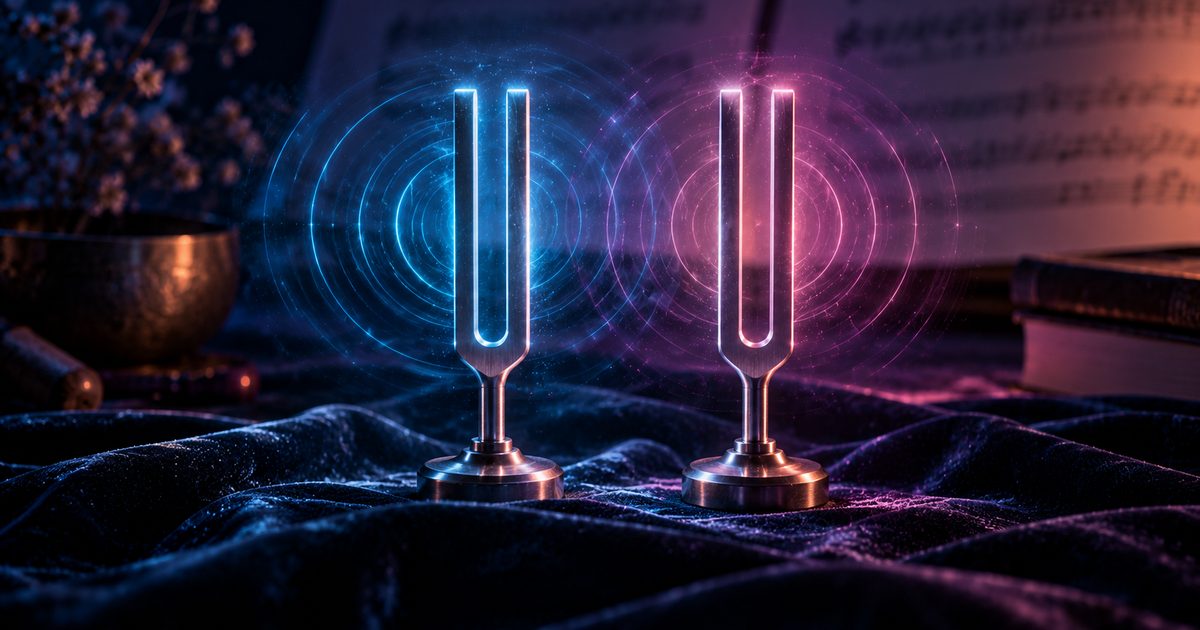
A lot of my music is tuned to 432 Hz, and "why 432?" is a fair question. Here's what the debate is actually about, without the myths.
What the numbers mean
When musicians tune, they agree on one reference note, the A above middle C, and tune everything else from it. Today the standard is A = 440 Hz: that note vibrates 440 times a second. Music "in 432" simply sets that A to 432 Hz instead, so every note in the piece is a fraction lower.
How much lower? About a third of a semitone. Played one after the other, most people can hear that 432 is slightly lower and often describe it as a little warmer or softer. Played on their own, very few people can tell which is which.
Where 440 came from
Tuning wasn't always standard. In past centuries, orchestras in different cities tuned noticeably higher or lower than each other, which made life hard for singers and instrument makers. France fixed its pitch at 435 Hz in 1859, and the composer Giuseppe Verdi is often linked with arguing for 432. In 1939 an international conference in London agreed on 440 Hz, and it was later adopted as an international standard. It was chosen to settle the confusion, not for any hidden reason.
What the claims say, and the evidence
You'll find plenty of bold claims online: that 432 Hz is "the natural frequency of the universe", that it heals, or that 440 was imposed to make people anxious. None of these stands up. There's no evidence that one tuning is more "natural" than the other.
There is a little research. A small Italian pilot study in 2019, with 33 volunteers, compared the same music at both tunings and found slightly lower heart rate and blood pressure with 432 Hz, but the differences were small and the study was tiny. It's interesting, not proof.
So why do I use it?
Because I like how it sounds for slow, meditative music. That slightly lower, softer pitch suits piano, singing bowls and long drones, and many listeners say they prefer it. That's a matter of taste, and it's a perfectly good reason to choose a tuning.
If you're curious, try it for yourself. In the mixer the Tones channel can play a pure 432 Hz note; switch it to a nearby pitch and listen to the difference.
For relaxation, not a medical treatment.
More from the journal
All articles
Solfeggio frequencies: what they are, honestly
Where the nine solfeggio frequencies come from, what is and isn't known about them, and why I still make music with them.

Why rain and thunder are my most popular tracks
Storms are what most people come to Tranquology for. Here's why I think that is, and how I put them together.
Is listening to gamma waves dangerous?
A straight answer about gamma binaural beats: what they are, who should be careful, and how to listen sensibly.